Project ongoing · Aerospace
Rocket
We build rockets, each one higher and faster than the last.
- the altitude to reach
- 3 km
- the maximum speed expected
- Mach 1
- the length, for a 110 mm diameter
- 2565 mm
- the altitude of Colombo 1, December 2025
- 600 m
For people who come from aerospace and mechanical engineering, electronics, physics
The mission
Colombo 3 is designed following the rules of the European Rocketry Challenge, EuRoC, the European competition for student-built rockets, organised by the Portuguese space agency. Following them means working with the rules of a real competition: a target altitude to hit, a minimum payload, recovery with two parachutes, safety documents.
The category chosen is the 3-kilometre one: the rocket has to get as close as possible to that altitude, carry at least 1 kg of payload in CanSat format, and come back to the ground whole, slowed by two parachutes. Precision counts more than power: that is why Colombo 3 has airbrakes.
- Liftoff the motor pushes
- End of thrust climbs under inertia, the airbrakes control the altitude
- Apogee, 3 km gas from a CO₂ cartridge deploys the drogue parachute
- Braked descent descends under the drogue parachute
- Main parachute opens lower down, the descent slows
- Landing the rocket is recovered whole
From Colombo 1 to Colombo 3
Colombo 1 flew in December 2025: it climbed to 600 metres, reached 617 km/h, about Mach 0.5, with accelerations of up to 20 G, and came back to the ground in one piece after 92 seconds.
Colombo 3 raises the target: five times the altitude and twice the speed, up to that of sound. Each rocket in the series tests what the next one needs: the onboard electronics, recovery with the parachutes, the simulations.
The numbers in the chart
| Rocket | Altitude |
|---|---|
| Colombo 1 (flown, December 2025) | 600 m |
| Colombo 3 (target) | 3000 m |
The numbers in the chart
| Rocket | Speed |
|---|---|
| Colombo 1 (flown, December 2025) | 617 km/h |
| Colombo 3 (target) | Mach 1, about 1225 km/h |
How it is made
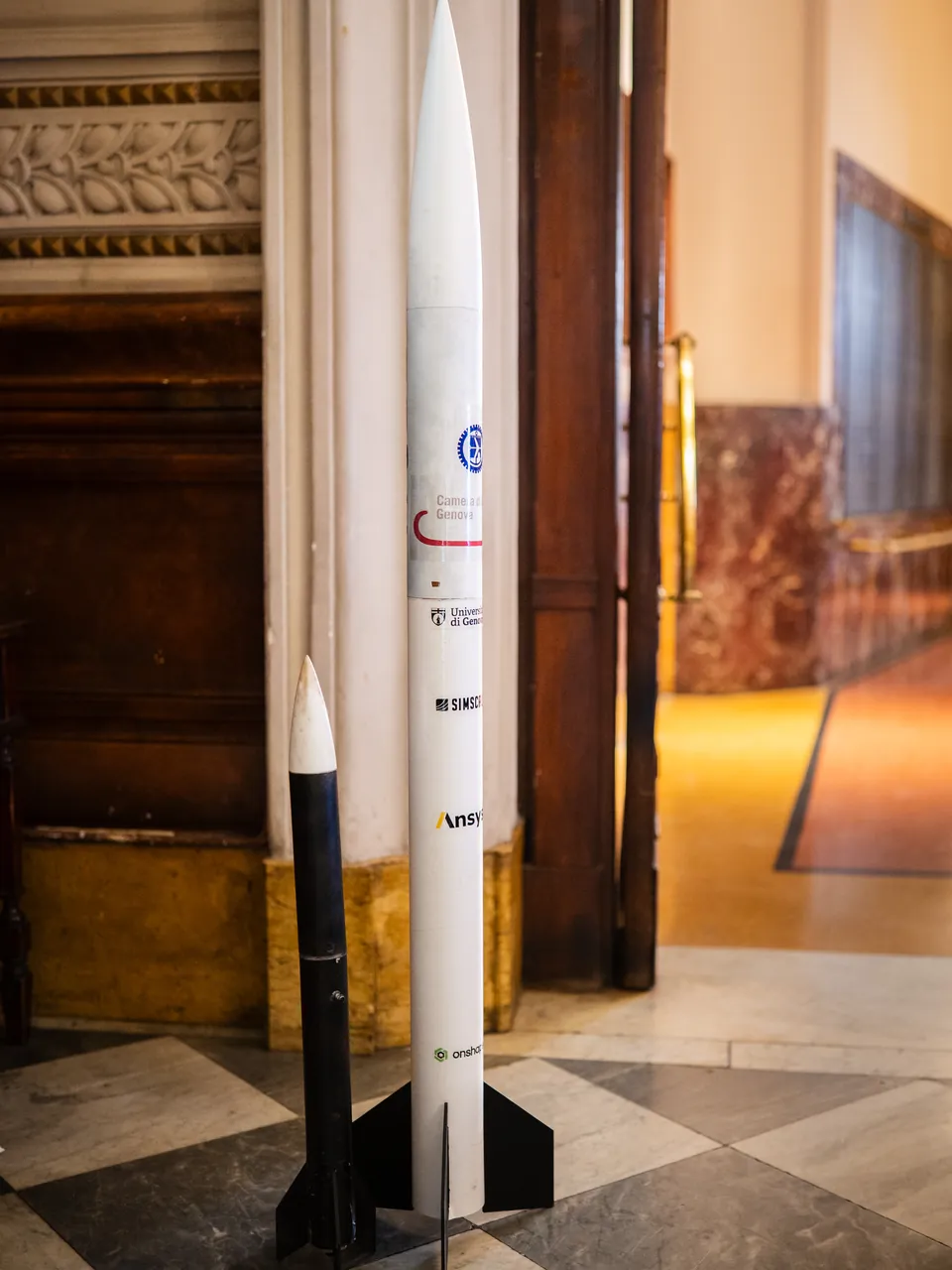
Colombo 3 is a single-stage rocket, stabilised by three fins. It is 2565 mm long and 110 wide: the length is 23 times the diameter. Inside, from the nose to the tail, the parts sit one behind the other, as in the diagram.
A structure of three U-channel longerons, 1500 mm long, holds the tail together: the motor is clamped at four points and the fins slot into the longerons' grooves.
- Nose cone curved profile, 400 mm long
- Payload three 66 × 115 mm CanSat modules
- Drogue parachute ejected by gas from a CO₂ cartridge
- Main parachute comes out through a side hatch
- Airbrakes three petals driven by a servo
- Bulkhead between the airbrakes and the motor
- Motor solid propellant; in the CAD, a 5-grain Cesaroni Pro75
- Fins three, at 120 degrees
The numbers in the chart
| da (mm) | a (mm) | |
|---|---|---|
| Nose cone | 0 | 400 |
| Payload | 400 | 745 |
| Drogue parachute | 778 | 1113 |
| Main parachute | 1115 | 1510 |
| Airbrakes | 1533 | 1595 |
| Bulkhead | 1645 | 1680 |
| Motor | 1755 | 2565 |
| Fins | 2298 | 2538 |
| Length | 2565 mm | from the tip of the nose cone to the end of the motor |
|---|---|---|
| Diameter | 110 mm | |
| Nose cone | 400 mm | curved profile, 1.83 litres in volume |
| Fins | 3, at 120 degrees | trapezoids with chords of 240 and 100 mm, a 100 mm span, 4 mm thick |
| Fin area | 510 cm² | 170 cm² each |
| Structure | 3 U-channel longerons | 1500 mm long, hold the motor and fins |
| Motor | solid propellant | commercial; in the CAD, a 5-grain Cesaroni Pro75 |
| Dry mass | less than 15 kg | design target |
| Payload | at least 1 kg | three CanSat modules |
- 01
CAD
The rocket is designed in Onshape piece by piece: the latest model has 188 bodies.
- 02
Trajectories
Simulations with 3 and 6 degrees of freedom in RocketPy and Matlab, including with changing wind.
- 03
Aerodynamics
CFD simulations in Ansys to find the centre of pressure and keep the rocket stable.
- 04
Structure
Finite element analysis to check that every part can withstand the flight loads.
The descent
Colombo 3 comes back to the ground in two stages. At apogee, the small drogue parachute opens and stabilises the descent. Lower down, the main parachute opens and slows the rocket down to landing.
The two systems are independent. In the first bay, gas from a CO₂ cartridge pushes a plate that slides on linear rails and carries the parachute out. The main one comes out sideways: two servos release a hatch and a second plate, pushed by elastic bands, pushes it out.
The cords that tie the parachutes to the rocket hold at least ten times the expected load, and swivels stop them twisting. The ejections are tested on the ground before every flight.
| Drogue parachute bay | from 778 to 1113 mm | from the tip |
|---|---|---|
| CO₂ cartridge | 22 × 89 mm | |
| Push plate | 254 × 56 × 17 mm | on 4 MGN7 linear rails |
| Main parachute bay | from 1115 to 1510 mm | |
| Side hatch | 320 × 56 mm | locked by 2 servos |
| Push plate | 258 × 54 × 17 mm | on 2 MGN7 linear rails |
| Cord attachments | M10 eyebolts | one per bay |
| Cords | safety factor of 10 | at least |
The airbrakes
Wind, air temperature and mass change from one launch to another, and so does the final altitude. To stop at 3 kilometres and no further, Colombo 3 brakes itself.
When the motor has burned out, and after a safety delay, a PID controller compares the predicted altitude with the target one and opens three petals out of the body: the more they extend, the more air they brake against. Before apogee the petals always retract.
The mechanism fits in 62 mm of rocket. A servo at the centre turns a 59-tooth gear, which drives three 24-tooth pinions; each pinion carries a petal. With this ratio the petals turn 2.46 times more than the servo.
- Petals at 150 degrees, servo at 61 17.3 cm² outside the body, 18% of the cross-section
The numbers in the chart
| Petals | Servo | Area outside | On the cross-section |
|---|---|---|---|
| 0° | 0° | 84 mm² | 0,9% |
| 30° | 12,2° | 528 mm² | 5,6% |
| 60° | 24,4° | 954 mm² | 10% |
| 90° | 36,6° | 1335 mm² | 14% |
| 120° | 48,8° | 1626 mm² | 17,1% |
| 150° | 61° | 1734 mm² | 18,2% |
| 180° | 73,2° | 1734 mm² | 18,2% |
The avionics
The onboard electronics are designed by the team, on circuit boards we make ourselves. They measure the flight, decide when to open the airbrakes and parachutes, and send the data to the ground. The important sensors are doubled up: if one gets it wrong, the other one notices.
Attitude comes from accelerometers and gyroscopes, combined with the other sensors through a Kalman filter. Two GPS antennas point in opposite directions, so the signal is not lost when the rocket spins. The data is also recorded onboard, in two copies.
The software is tested with the real electronics connected to a flight simulator, hardware-in-the-loop. On the pad, the electronics are armed from outside in a fixed order: recovery first, then telemetry, and motor ignition last.
| Processors | 2 | |
|---|---|---|
| Barometers | 2 | altitude from pressure |
| Accelerometers with gyroscope | 2 | acceleration and attitude |
| GPS | 1 | with two antennas |
| Pitot tube | 1 | airspeed |
| Thermocouples | 3 | temperatures |
| Servos | 3 | one for the airbrakes, two for the parachute hatch |
| Solenoid | 1 | in the drogue parachute bay |
| Radio | telemetry | antennas on different frequencies |
The payload
The rules call for at least 1 kg of payload. Colombo 3 carries three modules in CanSat format, cylinders 66 mm in diameter and 115 in height, stacked right below the nose cone. Each module weighs between 300 and 350 g.
Inside is a biophysics experiment that continues Zero-G's work: understanding what strong accelerations do to living cells and protein crystals. Crystals grown on the Space Station, for example, suffer impacts of up to 67 g on re-entry, and are damaged.
The payload is separate from the rocket, mechanically and electrically, and is qualified with temperature cycling, vibration and centrifuge tests.
Risks and checks
As the rules require, the team wrote the safety documentation: 31 risks, each with a score from 1 to 25, severity times probability, before and after the countermeasures.
At the start, 10 risks were critical. After the countermeasures, none of them are critical any longer: 8 remain high, 14 moderate, 9 low or very low. The sum of the scores drops from 343 to 217.
The numbers in the chart
| Risk | before the countermeasures | after |
|---|---|---|
| Vibrations that loosen parts | 20 | 8 |
| Attitude sensor errors | 20 | 12 |
| Delays in assembly | 20 | 10 |
| Distorted pressure readings in flight | 16 | 12 |
| Instability during ascent | 15 | 10 |
| Strong wind | 15 | 10 |
| Structural failure | 15 | 10 |
| Flight software errors | 15 | 10 |
| Parachute cord failure | 15 | 5 |
| Insufficient testing before the flight | 15 | 10 |
- 01
Vibrations
Fasteners with mechanical locking, and tests on a shaker table.
- 02
Attitude
Kalman filter, several sensors together, calibration before the flight.
- 03
Cords
Safety factor of 10, aerospace materials, tensile tests.
- 04
Stability
Simulations with 3 and 6 degrees of freedom, and CFD on the centre of pressure.
| Preliminary Design Review, PDR | completed | 25 February 2026 |
|---|---|---|
| Critical Design Review, CDR | completed | 27 February 2026 |
Where we are
- April 2025We presented the project at IRESS, the meeting for Italian students who build rockets, at Sapienza University in Rome.
- December 2025Colombo 1 climbed to 600 metres, at 617 km/h, and came back to the ground in one piece after 92 seconds.
- TodayWe are designing Colombo 3, a rocket for a 3-kilometre altitude, under the rules of EuRoC, the European rocket competition.
Photos

Videos

People on the project

Who we do it with


Sources
- Colombo 3, Safety Documentation, COL3-SAF-001, revision A, May 2026.
- CAD model of Colombo 3, Onshape, 14 May 2026.
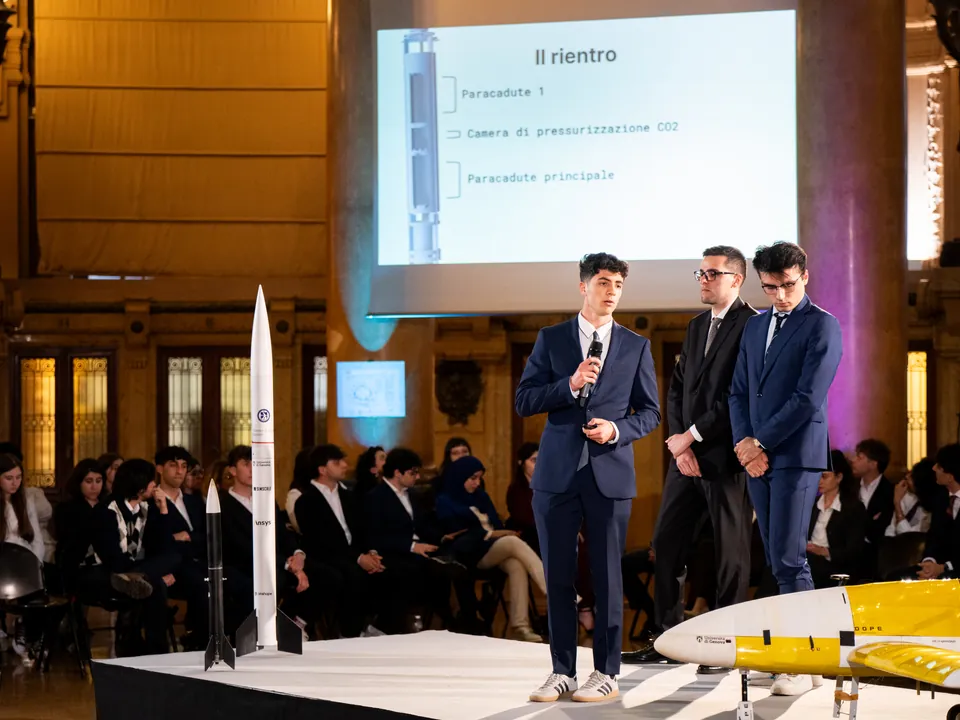
- Presentation at the Deep-Tech Showcase, Palazzo della Borsa, 21 April 2026.
- European Rocketry Challenge regulations, Portugal Space, euroc.pt.
Do you want to work on it?
You do not need experience and you do not need a CV. Write to us: we invite you to the next meeting, where you meet the team.